The Canon R5C: Stealth Cinema Power
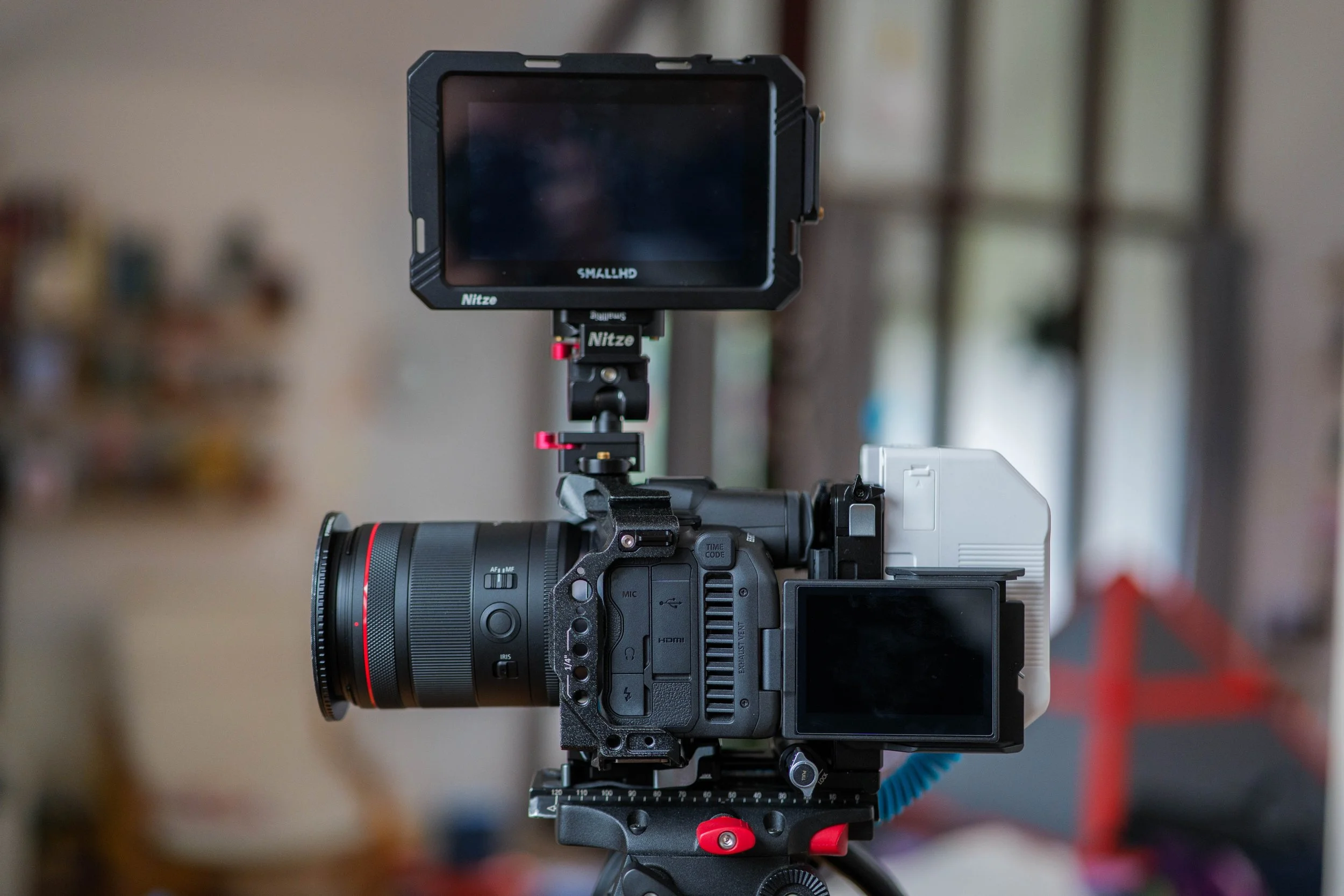
The Canon R5C sits in a sweet spot in my kit, a camera that looks completely unassuming in public, but under the hood delivers rich, cinematic 8K 12-bit RAW footage that holds up beautifully alongside my C400 or C80.
What I love about the R5C is how discreet it is. In public settings, transport hubs, city streets, markets, small shops, no one gives it a second glance. It looks like a stills camera, and people assume you’re just taking tourist snaps. That makes it incredibly useful for fly-on-the-wall, documentary-style shooting or any situation where you need to be present but invisible.
Despite its small form factor, the image is seriously impressive. The 8K RAW files are dense but beautiful, full of detail and flexibility in post. When paired with Canon’s RF glass or fast primes, the results are vivid, cinematic, and completely broadcast-ready. Then there’s the dual gain ISO function that gives extra flexibility in exposure when light is limited. It doesn’t feel like a compromise, just a different way of working.
That said, the R5C isn’t perfect. The micro HDMI port is, frankly, a bit of a joke on a cinema-capable camera. It’s fragile, fiddly, and limiting for proper monitoring or wireless video workflows. And while Canon Log 3 is serviceable, this camera is screaming out for Canon Log 2, especially given the dynamic range potential it has in RAW.
But here’s the thing. Used correctly, the R5C is adaptable and powerful. For gimbal work, travel shooting, or fast-paced b-roll, it shines. It boots into Cinema OS quickly and gives you full control over frame rates, LUTs, audio, and monitoring. It’s compact enough to rig creatively and reliable enough for second-cam use alongside much larger bodies.
Where I use it most:
B-roll alongside Canon C400 or C80
Public-facing shoots where discretion matters
Gimbal work where weight and size are an important factor
Secondary interviews where I want high quality but low footprint
In short, the R5C punches way above its size. It’s not my main camera, but it fills a niche that nothing else quite does, a stealth cinema tool that delivers serious images without drawing any attention at all.
Canon clearly released the R5C as something of a test platform, bridging cinema and mirrorless worlds with mixed success. And given the R5 Mark II addresses many of the R5C’s shortcomings, and the Canon C50 taking over its place in the C line of cinema cameras, it seems unlikely Canon will follow up with a true “R5C Mark II.” That’s a shame. With just a few improvements, better ports, C-Log 2, potentially a IBIS sensor, the R5C could have become a Swiss army knife for solo operators. As it stands, it’s a brilliant but slightly underbaked camera with real-world value if you know how to work with its limitations.
If you need to work quietly, quickly, and still deliver stunning footage, the R5C earns its spot every time.
If you’re planning a shoot that needs to stay light, discreet, and flexible, feel free to get in touch.